
Aluminum Extrusion vs Cast Aluminum: Strength, Cost, & Design
23 June 2026Aluminum is one of the most versatile materials in manufacturing — but not all aluminum parts are created the same way. Designers often need to choose between extruded aluminum and cast aluminum, and the decision impacts strength, cost, thermal performance, and design flexibility.
If you’ve ever asked “what is extruded aluminum vs cast aluminum” or wondered “is extruded aluminum stronger than cast aluminum,” this guide will help you understand the key differences and when to use each.
What’s the Difference Between Cast Aluminum and Extruded Aluminum?
The main difference lies in how each type is manufactured:
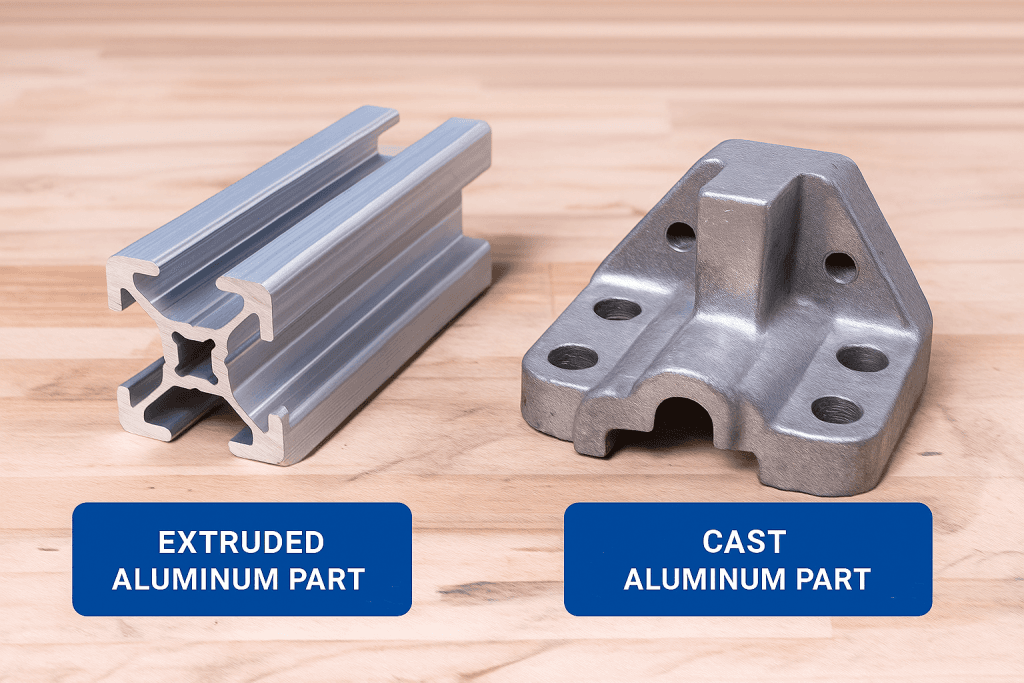
- Extruded Aluminum: Created by forcing heated aluminum billet through a die, producing a continuous profile with a consistent cross-section.
- Cast Aluminum: Made by pouring molten aluminum into a mold (sand casting, die casting, or investment casting) and letting it solidify.
This difference in manufacturing results in unique mechanical properties, cost structures, and design possibilities.
Strength: Is Extruded Aluminum Stronger than Cast Aluminum?
Generally, yes — extruded aluminum is stronger than cast aluminum when comparing similar alloys.
- Extrusion aligns the grain structure along the profile, increasing tensile strength and toughness.
- Cast aluminum may contain porosity or voids from cooling, which can slightly lower mechanical strength.
Use Cases:
- Extrusions: Load-bearing frames, structural supports, aerospace and automotive chassis parts
- Castings: Complex housings, brackets, engine components, and intricate parts where absolute strength isn’t critical
Thermal Conductivity & Heat Sink Applications
Another key difference between the two processes is thermal conductivity, which is critical for applications like heat sinks, LED lighting housings, and power electronics.
- Extruded Aluminum: Offers excellent thermal conductivity because of its dense, aligned grain structure. This makes it ideal for heat sinks, as fins can be extruded with long, consistent profiles that dissipate heat efficiently.
- Cast Aluminum: Has slightly lower thermal conductivity due to porosity and a coarser grain structure. Cast heat sinks are typically used when complex geometries are required, but they may not dissipate heat as effectively as extruded ones of the same size.
Bottom line: If you need maximum heat dissipation, extruded aluminum heat sinks are usually the first choice. If you need an intricate, compact design, a cast heat sink may be more appropriate.
Cost Considerations
- Extruded Aluminum: Lower tooling cost than casting, great for long linear profiles and continuous runs.
- Cast Aluminum: Higher upfront tooling cost, but better for high-volume, complex shapes that would be expensive to machine from extrusions.
Design Flexibility
- Extruded Profiles: Perfect for consistent cross-sections like rails, channels, and fins.
- Cast Parts: Can achieve irregular shapes, internal cavities, and near-net geometry that extrusions cannot.
Surface Finish and Secondary Operations
- Extrusions: Smooth surface right out of the press, easily anodized or powder-coated.
- Castings: May require machining or polishing for a smooth finish.
When to Choose Extruded vs Cast Aluminum
| Factor | Extruded Aluminum | Cast Aluminum |
| Strength | Higher, aligned grain structure | Lower, can have porosity |
| Thermal Conductivity | Excellent — preferred for heat sinks | Slightly lower, good for complex parts |
| Cost Efficiency | Best for linear profiles, high repeatability | Best for complex shapes in one piece |
| Design Flexibility | Limited to uniform cross-sections | Very high — complex shapes and cavities |
| Tooling Cost | Lower (extrusion die) | Higher (casting mold) |
Final Thoughts
So, what’s the difference between cast aluminum and extruded aluminum? Extrusion is best for strong, thermally efficient, linear profiles — making it perfect for heat sinks and structural applications. Casting is better for complex, intricate shapes that can’t be extruded.
If you’ve been wondering “is extruded aluminum stronger than cast aluminum,” the answer is yes in most cases, and it often has superior thermal performance as well.
Choosing the right process depends on your needs for strength, geometry, thermal conductivity, and cost. For many projects, combining the two methods — extrusions for structural or heat-dissipating parts and castings for complex connectors — provides the best of both worlds.