
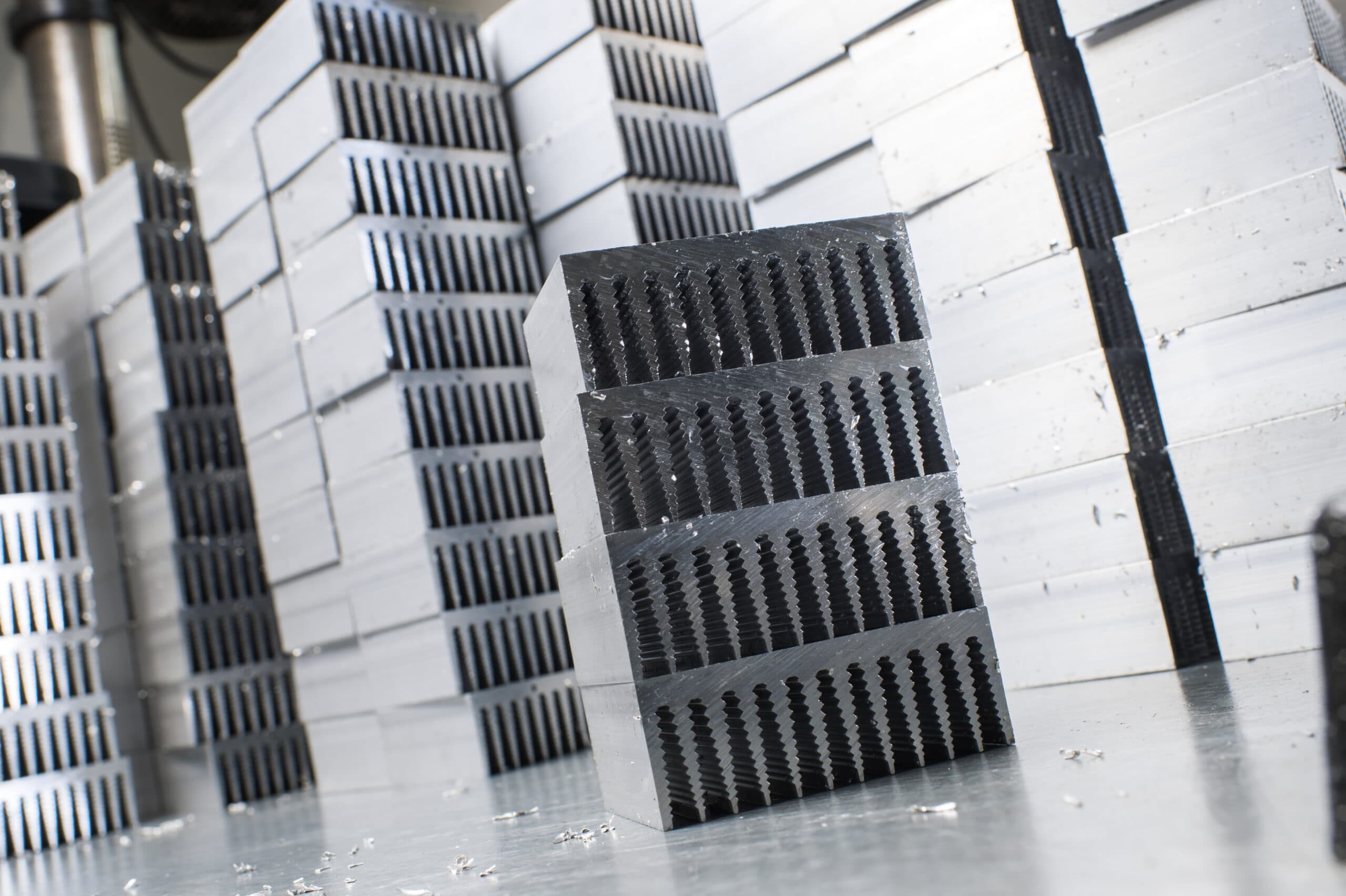
Extruded vs Cast Heat Sinks: Why Extruded Aluminum Remains Critical for High-Power Electronics
09 October 2026As artificial intelligence, electric vehicles, industrial automation, and power electronics continue advancing, thermal management has become one of the biggest engineering challenges in modern product design.
Today’s high-power electronic systems generate more heat than ever before. Without effective cooling, excessive temperatures can reduce performance, shorten component lifespan, and increase system failure rates.
To solve this problem, engineers rely heavily on heat sinks to transfer and dissipate heat away from sensitive electronic components.
While several manufacturing methods exist for producing heat sinks — including casting, skiving, forging, machining, bonded fin construction, and extrusion — extruded aluminum heat sinks remain one of the most widely used solutions across the electronics industry.
So why do extruded heat sinks continue dominating so many applications?
The answer comes down to balancing:
- thermal performance
- manufacturability
- scalability
- weight
- cost
- and design flexibility
What Is a Heat Sink?
A heat sink is a passive thermal management component designed to absorb and dissipate heat from electronic devices.
Heat sinks are commonly attached to:
- processors
- GPUs
- power supplies
- motor drives
- LED lighting
- battery systems
- telecommunications equipment
- AI server hardware
The heat sink transfers thermal energy away from the electronic component and releases it into the surrounding environment through airflow or liquid cooling systems.
Why Thermal Management Is Becoming More Important
Modern electronics are becoming:
- smaller
- faster
- more power-dense
- and more thermally demanding
This is especially true in:
- AI data centers
- EV power electronics
- industrial automation systems
- renewable energy infrastructure
- telecommunications equipment
AI infrastructure in particular is driving enormous demand for advanced cooling systems due to the massive heat generated by high-density GPU clusters.
As thermal loads increase, engineers are reevaluating which heat sink manufacturing methods provide the best overall performance.
Common Heat Sink Manufacturing Methods
There are several primary methods used to manufacture heat sinks today.
Extruded Aluminum Heat Sinks
Extrusion forces heated aluminum billet through a precision die to create continuous profiles with complex fin geometries.
Extruded heat sinks are commonly produced using 6063 aluminum alloy because of its:
- excellent extrudability
- strong thermal conductivity
- corrosion resistance
- good surface finish
- cost efficiency
Extrusion is one of the most common heat sink manufacturing methods due to its balance of performance and affordability.
Cast Heat Sinks
Cast heat sinks are typically produced using:
- die casting
- sand casting
- permanent mold casting
Casting allows manufacturers to create highly complex three-dimensional shapes that may not be achievable through extrusion.
Cast heat sinks are often used when:
- geometry complexity is extremely high
- airflow direction is multidirectional
- integrated features are required
- production volumes justify tooling investment
However, cast heat sinks also come with several tradeoffs.
Machined Heat Sinks
Machined heat sinks are CNC milled from solid aluminum or copper blocks.
Machining allows:
- very precise tolerances
- highly customized geometries
- rapid prototyping
- low-volume production flexibility
The downside is cost.
Machined heat sinks typically involve:
- higher material waste
- longer cycle times
- higher labor costs
- reduced scalability for large production volumes
Bonded Fin Heat Sinks
Bonded fin heat sinks attach separate fins onto a base plate using adhesives, brazing, or soldering.
This method allows:
- higher fin density
- taller fins
- improved thermal performance in certain applications
However, bonded fin designs can introduce:
- additional manufacturing complexity
- bonding reliability concerns
- higher production costs
Skived Heat Sinks
Skiving cuts thin fins directly from a solid block of metal.
Skived heat sinks can achieve:
- very thin fin structures
- high fin density
- strong thermal performance
They are often used in:
- high-performance computing
- aerospace
- telecommunications
But skiving can become expensive for larger production runs.
Why Extruded Heat Sinks Continue Dominating the Market
Despite the availability of alternative manufacturing methods, extruded aluminum heat sinks remain one of the most widely used thermal management solutions in the electronics industry.
1. Extruded Heat Sinks Offer the Best Cost-to-Performance Ratio
For many applications, extrusion provides the best overall balance between:
- thermal performance
- production speed
- tooling cost
- scalability
- manufacturability
Extruded heat sinks can achieve excellent cooling performance without the significantly higher costs associated with machining or bonded fin designs.
This makes extrusion particularly attractive for:
- industrial electronics
- AI server hardware
- LED lighting
- telecommunications equipment
- power supplies
- EV charging systems
2. Extrusions Produce Excellent Thermal Performance
Extruded aluminum heat sinks allow engineers to optimize:
- fin spacing
- fin height
- airflow geometry
- surface area
- structural rigidity
For many forced-air cooling applications, extrusion provides more than enough thermal performance while maintaining cost efficiency.
While copper offers higher thermal conductivity than aluminum, aluminum often remains preferred because it is:
- lighter
- easier to manufacture
- more cost effective
- easier to extrude into complex profiles
3. Extrusion Is Highly Scalable
Extrusion is extremely efficient for medium- and high-volume production.
Once tooling is developed, manufacturers can produce:
- long continuous profiles
- repeatable geometries
- high production volumes
- consistent dimensional quality
Compared to machining or skiving, extrusion dramatically reduces:
- material waste
- cycle times
- labor requirements
4. Extruded Heat Sinks Support Secondary Fabrication
Extruded profiles can easily be integrated with:
- CNC machining
- drilling
- tapping
- anodizing
- cutting
- assembly operations
This flexibility allows manufacturers to create customized thermal management solutions without requiring entirely different manufacturing platforms.
Where Cast Heat Sinks May Be Better
Although extruded heat sinks dominate many applications, cast heat sinks can outperform extrusion in certain situations.
Casting may be preferred when:
- highly complex 3D geometries are required
- airflow is multidirectional
- integrated mounting structures are needed
- extremely compact packaging is necessary
Cast heat sinks are commonly used in:
- automotive electronics
- compact consumer devices
- irregularly shaped enclosures
However, castings often sacrifice some thermal conductivity and dimensional consistency compared to extrusions.
Porosity can also become a concern in some casting processes.
Extruded vs Cast Heat Sinks: Key Differences
| Feature | Extruded Heat Sinks | Cast Heat Sinks |
| Thermal Conductivity | Excellent | Moderate to good |
| Cost Efficiency | Very high | Moderate |
| Scalability | Excellent | Good |
| Geometric Complexity | Moderate | Very high |
| Surface Finish | Excellent | Moderate |
| Dimensional Consistency | Excellent | Moderate |
| Weight Efficiency | Excellent | Good |
| Production Speed | High | Moderate |
| Tooling Cost | Moderate | Higher |
| Ideal Applications | Industrial, AI, telecom, LED | Complex compact electronics |
AI Infrastructure Is Increasing Demand for Extruded Heat Sinks
The rise of AI data centers is dramatically increasing demand for:
- GPU cooling systems
- server thermal management
- power electronics cooling
- liquid cooling support systems
Extruded aluminum heat sinks remain highly attractive because they combine:
- scalable production
- lightweight performance
- strong thermal conductivity
- cost efficiency
- customizable profiles
As AI computing continues growing, manufacturers increasingly need thermal management solutions that can be produced rapidly and economically at scale.
This plays directly to the strengths of aluminum extrusion.
Frequently Asked Questions
Why are most heat sinks made from extruded aluminum?
Extruded aluminum provides an excellent combination of thermal performance, lightweight strength, scalability, and cost efficiency.
Are cast heat sinks better than extruded heat sinks?
Not necessarily. Cast heat sinks are better for highly complex geometries, while extruded heat sinks often provide better cost efficiency, consistency, and scalability.
Why is aluminum preferred over copper for many heat sinks?
Although copper conducts heat better, aluminum is significantly lighter, less expensive, easier to manufacture, and better suited for extrusion.
What industries use extruded heat sinks?
Common industries include:
- AI data centers
- telecommunications
- industrial automation
- EV charging
- LED lighting
- renewable energy
- power electronics
Conclusion
As high-power electronics continue evolving, thermal management is becoming increasingly critical across nearly every major industry.
Although multiple heat sink manufacturing methods exist, extruded aluminum heat sinks continue dominating the market because they offer one of the best overall combinations of:
- thermal performance
- manufacturability
- scalability
- lightweight design
- and cost efficiency
While cast, machined, bonded fin, and skived heat sinks each have specialized advantages, extrusion remains one of the most versatile and economical thermal management solutions available for modern electronic systems.
For manufacturers developing AI infrastructure, industrial electronics, telecommunications systems, or power electronics, extruded aluminum heat sinks continue to provide a highly effective solution capable of supporting both performance and large-scale production demands.