
How to Bend Aluminum Extrusions (and When You Shouldn’t)
05 June 2026Aluminum extrusions are strong, lightweight, and versatile — but what if you need a curve instead of a straight profile? Many engineers, fabricators, and DIY builders eventually ask: how to bend aluminum extrusions and, more importantly, when bending might not be the right choice at all.
In this guide, we’ll cover common methods for how to bend extruded aluminum, best practices for avoiding damage, and scenarios where bending isn’t recommended — plus a key design tip that can make bending easier and more cost-effective.
Can Aluminum Extrusions Be Bent?
Yes — aluminum extrusions can be bent, but not all profiles bend equally well. Because they are made by pushing heated aluminum through a die, extrusions often have sharp corners, hollow voids, and thin walls that make them more prone to cracking or distortion when bent.
The most bend-friendly alloys are:
- 6063: Often used for architectural and framing extrusions, with excellent formability
- 6061: Stronger, but more likely to crack — may require special processing before bending
How to Bend Aluminum Extrusions
Here are the most common methods for bending extruded aluminum:
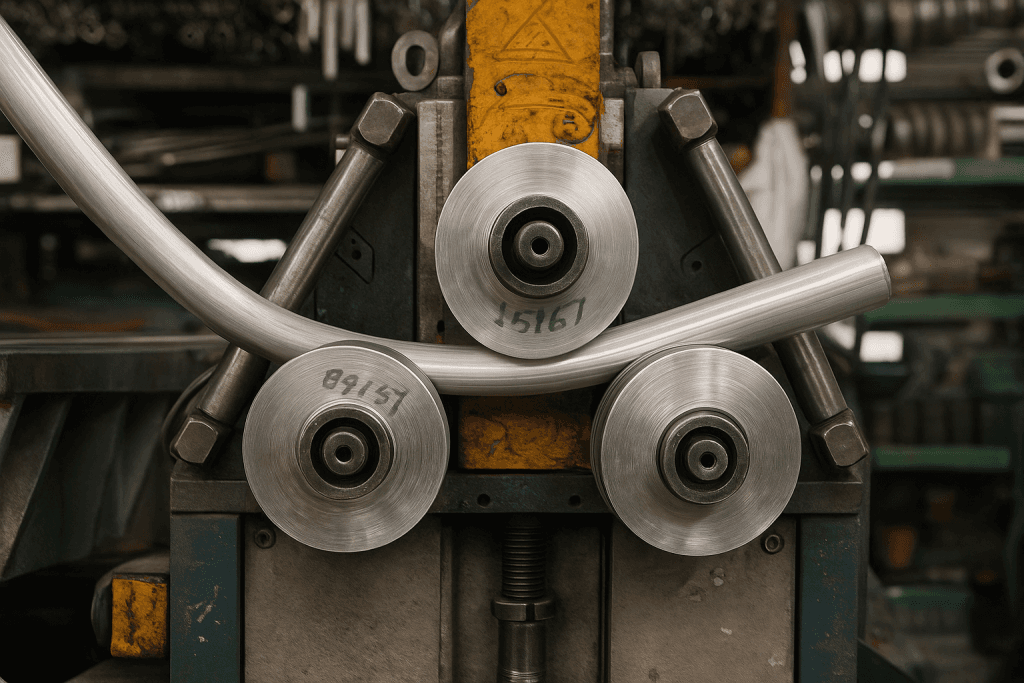
1. Roll Bending (Best for Long, Gentle Curves)
- Uses a 3-roll bending machine to gradually curve the extrusion
- Works well for T-slot profiles, pipes, and channels
- Ideal for consistent, large-radius bends
2. Press Bending
- Uses a hydraulic press and a forming die to create a single, controlled bend
- Suitable for short lengths or defined angles
- Risk of distortion on thin-walled or hollow profiles
3. Stretch Forming
- Clamps the extrusion, stretches it, and pulls it around a form
- Produces smooth, accurate curves with minimal wrinkling
- Commonly used in aerospace, transportation, and architectural industries
Make Bending Easier with T4 Temper Extrusions
If your project requires significant bending, talk to your extrusion supplier about ordering your profiles in the T4 (soft) temper.
- What is T4? T4 temper means the extrusion has been solution heat-treated but not artificially aged, making it softer and more ductile for forming.
- Why it helps: Bending T4 aluminum reduces the risk of cracking and allows for tighter bend radii without damaging the profile.
- After bending: The parts can be age hardened (artificially aged to T5 or T6) to regain strength.
Understanding Age Hardening & Springback
Aluminum alloys like 6061 and 6063 gain strength through precipitation hardening (also known as age hardening). After bending in the T4 condition, the part can be aged in a controlled heat-treatment process, increasing hardness and strength.
However, you should be aware of springback — the tendency for the metal to slightly relax after forming. Softer tempers exhibit more springback, so bends may need to be slightly over-formed to achieve the desired final angle or radius. A knowledgeable extrusion supplier can help you plan for this during design.
When You Shouldn’t Bend Aluminum Extrusions
Bending isn’t always the best solution:
- Profiles with multiple hollow voids: These may collapse or wrinkle during bending
- Very tight radii: May exceed the minimum bend radius for the alloy/temper
- Applications with strict dimensional tolerances: Bending can distort slots and flatness
Alternative Solutions
If bending isn’t ideal, you might consider:
- Miter cutting and joining: Cut and fasten sections at angles with brackets or welding
- Custom extrusion design: Work with your supplier to design a profile with the desired curve or angle built in
- Machined or cast components: For small, high-precision parts
Final Thoughts
Learning how to bend aluminum extrusions is an important skill, but bending is not always the most cost-effective or precise solution.
If you must bend, ordering extrusions in T4 temper and working with a supplier who understands age hardening can dramatically improve your results, reduce cracking, and make downstream machining easier.
And if bending proves impractical, a custom extrusion design that incorporates your required geometry can save time, eliminate secondary processing, and lower your overall production cost.
So, next time you ask yourself how to bend extruded aluminum, consider whether designing smarter — not bending harder — might be the better solution.